
Sharjah: The 9th ‘Desert Theatre Festival’ opens with Ruler in attendance
Sharjah: Sheikh Dr. Sultan bin Mohammed Al Qasimi, a member of the Supreme Council and the ruler of Sharjah, attended the opening of the ninth Sharjah Desert Theatre Festival on Friday. Sheikh Sultan bin Ahmed bin Sultan Al Qasimi, the deputy ruler of Sharjah, was also present. The festival continues until December 17.
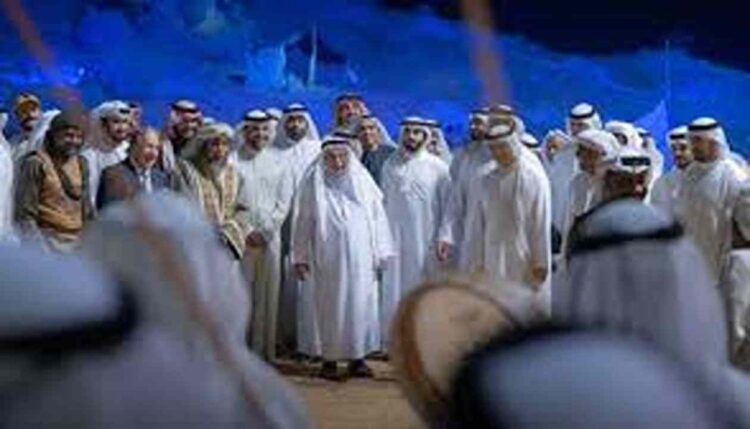
On the first day, the Sharjah Ruler wrote a play called “Al Barraq and Layla Al Afeefa,” which was performed in the Al Kehaif neighborhood of Sharjah.
Sheikh Dr. Sultan gave high marks to the performers’ performances, the screenplay, the incorporation of lyrical language, and the sophisticated methods used in the theatrical production. He pointed out that the play, which stands out for the variety of its features, had been enhanced with concepts, spectacles, and cinematic presentations. Sheikh Dr. Sultan confirmed that the Sharjah National Theatre’s resources and dedication were completely accessible, allowing the piece to be performed at this festival under the name of the United Arab Emirates.
The Sharjah ruler said that the play “Al Barraq and Layla Al Afeefa” intends to compete with submissions from other Arab nations and win the festival’s prize. He made it clear that the United Arab Emirates as a whole, not just him or Sharjah, is the recipient of the prize.
The drama “Al Barraq and Layla Al Afeefa” is different from any other work, according to Sheikh Dr. Sultan, since it features conflict and rivalry amongst participating nations. He commended the work of director Mohammed Al Ameri, emphasizing his skill in creating a huge and intricate piece, his command of the performing arts, and the smooth transition between stage acting and cinematic performances, all of which contributed to the production’s overall brilliance and complexity.
The necessity of promoting theater and having supporters and elevators was emphasized by the ruler of Sharjah. He recalled the year 1954, when he directed a play whose message was so potent that it brought in 30,000 rupees at the time, and said that he is among those who have dedicated themselves to theater from an early age. He clarified that this was no accident since the show took place during a Sharjah holiday, when people customarily congregated under the “Ruwla tree,” where the tickets were offered.
Sheikh Dr. Sultan said that there were many individuals in the audience, including sheikhs at the time, and that this acknowledgment was a great accomplishment for a theater run by young people. He challenged everyone who is enthusiastic about theater to unite and to rise beyond trivialities in theater activity.
Sheikh Dr. Sultan discussed the Sharjah Performing Arts Academy’s efforts to encourage theater, pointing out that the school would generate a big number of highly competent and brilliant graduates from the Arab world and beyond. He emphasized that students get guidance and assistance throughout their education and when they start their jobs in this industry. Sheikh Dr. Sultan said that graduates run the danger of disappearing if they don’t get the right care, and he clarified that this strategy has been considered in academy meetings in order to produce noticeable outcomes. He emphasized that all nationalities are welcome at the institution and that there are a sizable number of registered pupils.
The Ruler of Sharjah emphasized the need for theatrical activity to be free from limited regionalism and stressed the need of encouraging goodwill and spirit in this sector since elevating individuals contributes to the progress of theater. He emphasized that theater must convey a powerful and significant message and cautioned authors, directors, and theater professionals against being sucked into lighthearted or inconsequential productions. When he created a play in the late 1950s and early 1960s, he clashed with the British delegate, who had been invited to a major theatrical production, and he was the first to encounter such difficulties, he said. The theater was then forced to shut, props were seized, and his completed projects—including plays he had written himself—were confiscated.
He stated his hope that those who operate in this profession are credible and have trust in what they say. In order to stand among the greats and represent the country in international theatrical contests, Sheikh Dr. Sultan counseled authors, playwrights, and directors to advance their craft quickly.
Sheikh Dr. Sultan saw performances by the folk troupe and heritage sections when he first arrived at the festival site, which honors Arab desert landscapes and showcases their customs, traditions, and artistic history via the aesthetics of theater. The actors’ competence and capacity to integrate cultural history into situations that connect with the audience and deepen their ties to cultural traditions were shown in these performances.
His recently written play, “Al Barraq and Layla Al Afeefa,” which vividly depicts a wonderful tale from Arab history that has been maintained in the Arab literary tradition, was attended by the Ruler of Sharjah. The drama is inspired by Arab poetry that captures historical narratives and celebrates bravery, chivalry, valor, loyalty, commitment, and love for the nation. The poems, which are full of eloquence and vivid imagery, have endured for centuries in the communal memory.
To increase the intensity of each scene and strengthen the audience’s connection to the events, the theatrical production also used video performances and vivid expressive approaches. The performance was made more realistic by the addition of horses and camels, which transformed lyrical images into concrete events that spectators could relate to. Because of their strong links to the real Arab world and their capacity to exemplify the play’s portrayal of chivalry and valor, these visual components served as a crucial component in delivering the artistic and cultural message.
Many well-known Arab and local performers, such as Ahmed Al Jasmi, Basel Yakhour, Ibrahim Salem, Abdullah Masoud, and Azza Zarour, performed in the Sharjah National Theatre performance. Mohammed Al Ameri directed the play.
The goal of this edition, which has as its topic “Desert Theatre and the Aesthetics of Arab Folk Narratives,” is to investigate the creative and technical opportunities presented by Arab folktales in order to enhance and broaden the desert theater experience. On the evening of December 17, the festival’s ninth edition will come to an end.
The festival kickoff is attended by dignitaries and senior authorities.