
RefugeeCamps – Persistent Fire Risks Expose Structural Gaps in Rohingya Settlements
RefugeeCamps – Bangladesh’s management of fire safety in the Rohingya refugee settlements has highlighted a troubling contradiction: while emergency relief systems respond quickly to fires, the deeper causes that allow these incidents to happen repeatedly remain largely unresolved. International organisations had earlier proposed constructing around 50,000 semi-permanent shelters designed to be more resistant to fire. However, following reductions in global humanitarian funding in early 2025, the ambitious housing initiative has yet to secure the financial support required for implementation.
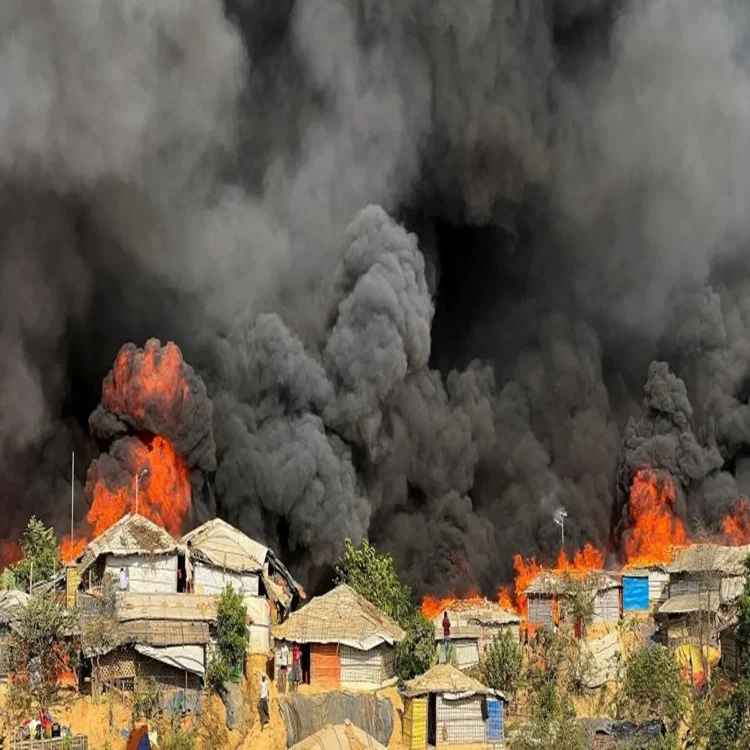
Thousands of Fires Recorded Over Several Years
Data compiled in a report published by Global Voices indicates that fires have become a recurring reality in the vast refugee camps located in southeastern Bangladesh. Between May 2018 and December 2025, at least 2,425 separate fire incidents were officially documented across the settlements.
The scale of the damage is significant. More than 100,000 refugees have been affected during this period, while over 20,000 shelters have been destroyed by flames. According to the report, the frequency of these events suggests that the situation cannot be viewed simply as a series of accidental fires. Instead, it reflects a broader humanitarian challenge in which temporary solutions have gradually turned into a prolonged and fragile living system.
Camp Conditions Increase Fire Vulnerability
The report further explains that the structural design of the camps itself contributes to the continuing danger. The refugee settlements in Cox’s Bazar, which house nearly one million displaced Rohingya people, consist primarily of makeshift shelters constructed from bamboo frames, plastic sheets and tarpaulin.
These materials offer little resistance to fire and can ignite quickly. In addition, some sections of the camp are extremely crowded, with population density exceeding 95,000 residents per square kilometre in certain blocks.
Daily activities within the camps also increase the risk. Many families rely on small cooking stoves or open flames to prepare food, often in tightly packed shelters located only a few feet apart. During the dry winter months, the bamboo and plastic structures can become highly flammable, allowing fires to spread rapidly through entire neighbourhoods.
Humanitarian Agencies Warn of Widespread Impact
Officials working with international humanitarian organisations say that the consequences of such fires extend well beyond the loss of individual homes.
Lance Bonneau, the Chief of Mission for the International Organization for Migration in Bangladesh, noted that fires in overcrowded refugee settlements disrupt multiple aspects of daily life. When a blaze occurs, families often lose their shelter, personal belongings, and access to essential services such as food distribution points, sanitation facilities, and health clinics.
For many residents, rebuilding after each fire becomes an ongoing cycle of displacement and recovery within the same settlement.
Aid Groups Expanding Fire Prevention Efforts
Humanitarian agencies operating in the region have been working to strengthen fire prevention measures alongside emergency response systems. After a major fire in January 2026 that forced more than 2,100 people to leave their shelters, aid organisations mobilised relief teams to assist affected families.
Kaiser Rejve, Head of Programmes at CARE Bangladesh, stated that future initiatives will place greater emphasis on prevention. According to him, training sessions on fire safety will be incorporated into programmes focused on shelter upgrades and maintenance. The aim is to raise awareness among residents and encourage safer practices within the camps.
Such efforts are expected to include guidance on safer cooking arrangements, improved storage of fuel materials, and better coordination with volunteer firefighting teams within the settlements.
Long-Term Solutions Face Political and Financial Barriers
Despite these measures, experts say that meaningful improvements remain difficult to achieve because of the broader political context surrounding the Rohingya crisis.
Most of the refugees have been living in Bangladesh since fleeing violence in Myanmar in 2017. Although the camps have existed for more than eight years, the Bangladeshi government continues to view the settlements as temporary facilities rather than permanent communities.
As a result, large-scale investments in durable infrastructure — such as fire-resistant housing, expanded roads for emergency vehicles, or permanent utility systems — are often considered politically sensitive.
Humanitarian agencies therefore operate within strict limitations, focusing largely on short-term relief and basic services while attempting to reduce risks within the existing framework.
For the nearly one million Rohingya refugees living in Cox’s Bazar, the repeated fires illustrate how fragile living conditions remain in one of the world’s largest refugee settlements, where safety, funding, and long-term planning continue to intersect with a complex humanitarian and political situation.