
Islamabad : Land Dispute Sparks Widespread Public Anger Over Compensation Policies
Islamabad: Hundreds of residents from Pakistan’s federal capital recently took to the streets after long-standing grievances over land acquisition resurfaced, triggering renewed public outrage. Landowners from the C-16 and H-16 sectors of Islamabad protested against decisions made by the Capital Development Authority, alleging that official policies have systematically deprived them of their lawful rights. The demonstrations reflected years of frustration, mistrust, and unresolved disputes linked to compensation mechanisms and development planning in the capital.
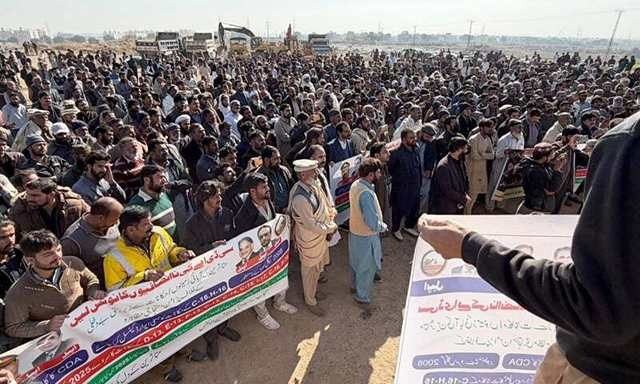
Background of the Islamabad Protests
The protests gained momentum after reports suggested that Prime Minister Shehbaz Sharif might soon inaugurate major public projects, including the Jinnah Medical Complex and Daanish University in the H-16 sector. For many affected residents, this news symbolized the final stage of a process in which their land would be permanently absorbed into large-scale development without what they consider fair compensation. As a result, families gathered in large numbers to publicly voice objections and demand accountability from authorities.
Concerns Over Built-Up Property Awards
At the center of the dispute lies the Built-Up Property award system introduced by the CDA. Protesters argue that while earlier sectors such as C-13, C-14, and C-15 received compensation based on existing structures at the time of acquisition, the same principle was not applied consistently to C-16 and H-16. According to residents, the authority relied on outdated satellite data from 2008 to calculate compensation, ignoring physical developments that took place over the following decade.
This discrepancy, landowners claim, has resulted in unequal treatment and arbitrary outcomes. Families have grown, additional housing units have been constructed, and community infrastructure has expanded since 2008. Protesters insist that excluding these developments from assessment amounts to ignoring the lived reality of thousands of residents.
Land Acquisition Policy and Unfulfilled Commitments
Under the land acquisition policy announced in 2008–09, landowners were assured specific benefits. These included one kanal of developed land for every four kanals acquired and a five-marla plot for every 300 square feet of constructed area. Residents argue that these assurances were central to their acceptance of the acquisition process.
However, they allege that the CDA delayed announcing Built-Up Property awards for years, only to later impose restrictive conditions that disqualified many rightful claimants. According to demonstrators, if the awards had been issued in a timely manner, families would not now be facing legal uncertainty or economic loss.
Economic Disparities and Market Value Issues
One of the strongest points raised during the protests concerns the disparity between acquisition prices and resale values. Protesters highlighted that land acquired at rates of a few hundred thousand rupees per kanal was later sold by the authority for tens of millions. This gap has fueled perceptions of exploitation and unfair enrichment at the expense of local communities.
Representatives of affected residents argue that compensation must be reassessed according to current market values rather than historical benchmarks. They believe this approach would better reflect the economic realities of urban expansion and rising property prices in Islamabad.
Official Response and Use of Satellite Data
In response to public criticism, CDA spokesperson Shahid Kiani stated that the authority relied on satellite imagery from SUPARCO dating back to 2008 to determine lawful ownership and eligibility. According to the CDA, any construction carried out after that period is considered unauthorized and therefore ineligible for compensation.
While the explanation outlines the legal basis for the authority’s decisions, it has failed to satisfy protesters. Many argue that rigid reliance on outdated data ignores demographic growth, housing needs, and delays caused by the authority itself.
Governance Challenges and Public Trust
The controversy has broader implications for governance and urban planning in Pakistan. Critics argue that the dispute reflects systemic weaknesses in land management, transparency, and citizen engagement. Residents believe that policies designed without flexibility or ground-level verification erode public trust and deepen social divides.
As reported by Dawn, representatives of the Affected Persons Alliance have warned that demonstrations will continue if the new notifications are not withdrawn and compensation policies are not revised. Their demands focus on fairness, consistency, and recognition of genuine residents who have lived in these areas for decades.
Future Outlook and Possible Escalation
Despite official clarifications, tensions remain high. Protesters insist that unless authorities adopt a more inclusive and realistic approach, the situation could escalate further. For many residents, the dispute is no longer just about land but about dignity, economic security, and the right to be treated fairly by state institutions.
The Islamabad protests highlight the urgent need for policy reform that balances development goals with social justice. How the authorities respond may set a precedent for future urban expansion projects across Pakistan.