
India-US : ties be put to the test in 2025 due to tariffs and Pakistan’s tilt Expert (IANS interview)
India-US: Despite the two strategic partners’ quiet but significant advancements in defense, technology, and energy cooperation, 2025 has emerged as a testing period for India-US relations, characterized by significant trade frictions and renewed US engagement with Pakistan, according to a top India-US policy expert.
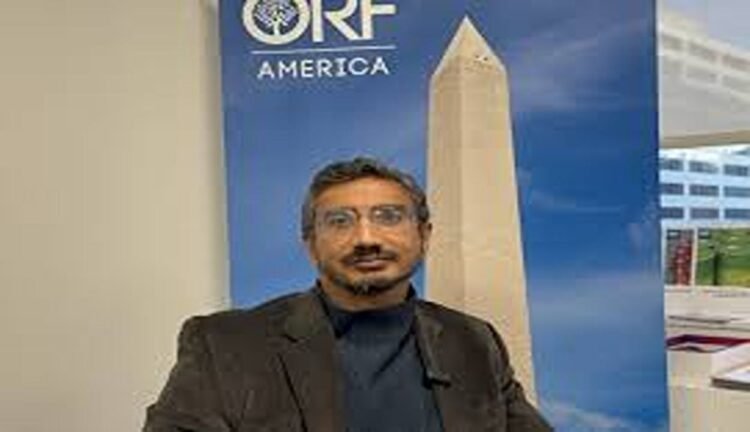
Dhruva Jaishankar, executive director of the Observer Research Foundation America, said IANS in an interview that 2025 has been a difficult year for India-US ties, citing the two biggest issues facing the partnership.
“The two biggest challenges have been tariffs, which put Indian exporters at a disadvantage and are still very high. The 50 percent tariffs on India are among the highest that the US applies anywhere,” he added. The second was “a slight restart and particularly high level engagement of US-Pakistan relations between Pakistan military leadership,” Jaishankar said.
Despite the fact that the partnership started the year on what he called a “very promising note,” he said that these events had caused “some erosion of trust between the US and India.”
However, Jaishankar emphasized that 2025 had also been “paradoxically a very good year for US-India relations in some other ways,” with significant advancements that have gone unnoticed by the general public.
He cited enhanced military drills involving all three services, the new US-India defense framework, and ongoing defense sales as examples of “some breakthroughs on defense.” Along with advancements in space collaboration and energy links, including “a major deal” on liquefied petroleum gas, he also highlighted what he called “a landmark year for AI investment from the US to India.”
According to Jaishankar, it’s a mixed picture. “There’s a good reason why the headlines have been unfavorable. However, below that exterior, I believe some really beneficial advancements have been made in a few areas.
However, the most obvious and politically delicate fault line is still trade. Following Vice President JD Vance’s travel to India, Jaishankar said that India had started talks “very early with the Trump administration in February, March” and that there were strong hopes the transaction would be finalized by April.
“It was already in a fairly advanced state because the US and India signed the terms of reference,” he said.
He blamed the delay on disagreements over operational matters and the connection between trade negotiations and irrelevant problems. The agreement is “within reach,” he said, but is limited by “the politics of it rather than the economics of it.” He added that other concerns, including India’s imports of Russian oil, were entangled in the trade discussions.
Jaishankar pointed out that India has made headway with the European Union and Israel, reopened negotiations with Canada, and signed trade deals with the UK, Oman, and New Zealand. “There is a growing sense of frustration in New Delhi, but the offer is still on the table,” he said.
Bilateral trade flows have continued to increase unevenly in spite of punitive tariffs. According to Dhruva Jaishankar, US exports to India climbed by only 3% during the first eight months of 2025, but Indian exports to the US surged by “almost 25%.”
He said that while certain industries and businesses have been impacted, “overall it hasn’t had as much of an impact as many feared.” “So it doesn’t seem that President Trump’s objective of balancing trade between the US and India is being met,” he said.
President Donald Trump and Prime Minister Narendra Modi talked “at least four times” in the latter months of 2025, and cabinet-level interactions resumed after a hiatus, indicating attempts on both sides to stabilize relations, he added.
He noted “some fruitful agreements on defense, on energy” and said that “there has been a resumption… of cabinet-level contacts and meetings between the two sides.”
But New Delhi is uneasy by the concurrent resurgence of US-Pakistan ties. Jaishankar characterized the relationship as “still substantively quite thin,” emphasizing that bilateral commerce is still low and that significant US defense sales to Pakistan have not resumed.
“However, there are two perspectives on the relationship with Pakistan,” he said. Pakistan is “useful for certain contingencies for the US and the Middle East,” such as Afghanistan, Iran, Gaza, and Saudi Arabia’s security. The first is military-to-military interaction.
“The second aspect” is that Pakistan has economic potential, especially in “critical minerals, cryptocurrency, and certain other areas,” he said. Although some US lending and offtake agreements have resulted from this, Jaishankar emphasized that it is still “quite modest compared to what the US-India economic relationship” represents.
Over the last 20 years, India and the US have developed a complex alliance that includes people-to-people relations, technology, education, and defense. Both administrations have consistently referred to the relationship as one of the most important of the twenty-first century, despite occasional instability.
Despite trade disagreements and regional geopolitics testing the sustainability of their strategic alignment, Washington and New Delhi continue to have convergent interests in the Indo-Pacific.