
EU Free : India Seen as Primary Gainer From Newly Finalised Trade Pact
EU Free: The recently concluded Free Trade Agreement between India and the European Union is expected to tilt decisively in India’s favour, according to comments made by United States Trade Representative Jamieson Greer. Speaking in a televised interview, Greer pointed to expanded market access, labour-related advantages, and potential worker mobility provisions that could place India in a stronger economic position as global trade patterns continue to shift.
Shifting Trade Priorities Shape the Deal’s Impact
Greer framed his assessment within the broader context of changing international trade strategies, particularly the United States’ renewed focus on domestic manufacturing. Under President Donald Trump’s approach, policies have increasingly favoured local production, making access to the US market more costly for foreign exporters. As a result, trade-dependent economies are adjusting their strategies.
According to Greer, this shift has prompted the European Union to diversify its export destinations. With the US becoming a less accessible market, the EU is seeking alternative partners capable of absorbing its industrial output, and India has emerged as a natural choice due to its scale and growth trajectory.
European Union Looks Beyond the US Market
The European Union’s reliance on external trade has made it especially sensitive to changes in US policy, Greer noted. As American import conditions tighten, European exporters are under pressure to secure new outlets. India’s large consumer base and expanding industrial sector make it an attractive destination.
Greer said his review of the agreement’s early details suggests that the balance of benefits favours India. He described the EU’s outreach as a strategic move driven by necessity, rather than a purely reciprocal realignment of trade priorities.
Market Access and Workforce Mobility
One of the most significant outcomes of the agreement, according to Greer, is the improved access Indian businesses are expected to gain in European markets. Lower trade barriers and clearer regulatory pathways could help Indian manufacturers and service providers compete more effectively across the EU.
He also highlighted the possibility of expanded mobility arrangements for Indian workers. While noting that specific provisions are still being clarified, Greer referenced public statements from European leadership indicating an openness to facilitating the movement of skilled Indian professionals. Such measures, if implemented, could strengthen economic ties while addressing labour shortages in certain European sectors.
Labour Costs and Manufacturing Capacity
India’s cost-competitive labour force and growing manufacturing base were cited as additional factors enhancing its position under the agreement. Greer contrasted the EU’s continued embrace of globalised supply chains with the US effort to reassess and recalibrate globalisation’s domestic impacts.
From his perspective, the combination of lower production costs and wider market access could give Indian exporters a meaningful advantage at a time when global companies are reassessing where and how they produce goods.
US Monitoring India’s Russian Oil Imports
During the interview, Greer also addressed questions surrounding US concerns over India’s continued purchase of discounted Russian oil. He acknowledged that India has reduced its reliance on such imports but said further progress is expected.
Greer noted ongoing dialogue between US and Indian officials on the issue, describing the relationship as constructive. He added that recently strengthened sanctions introduced by the US Treasury Department are intended to accelerate a gradual reduction in these purchases, and that developments are being closely monitored.
A Landmark Agreement With Global Implications
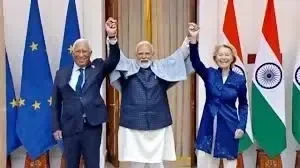
Greer’s remarks followed the formal conclusion of FTA negotiations between India and the European Union, an agreement both sides have described as a landmark achievement. Often referred to by officials as a foundational economic partnership, the deal aims to reflect modern trade rules while addressing current global economic challenges.
The agreement links two of the world’s largest economies, representing a combined market valued at approximately USD 24 trillion. With a shared population of nearly two billion people, the partnership is expected to open new avenues for trade, investment, and innovation, reinforcing India’s growing role in the evolving global economic landscape.