
China : shows off its military might in Taiwan
China : Taiwan is often subjected to military coercion by China. The extent of the People’s Liberation Army’s (PLA) current attacks on Taiwan is unprecedented, a standard China has been actively working to attain.
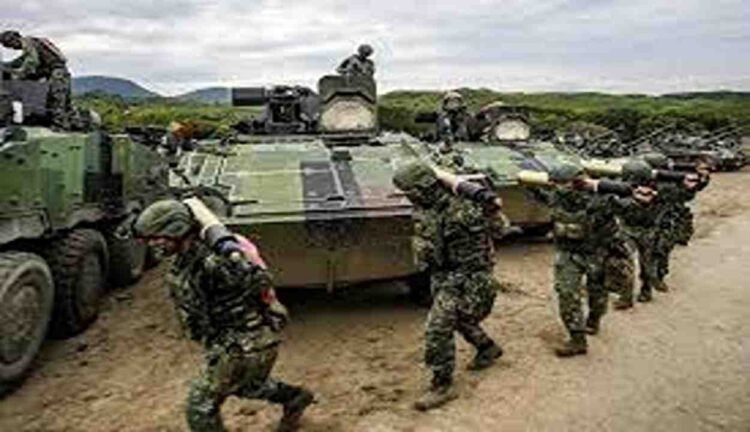
The PLA carried out 5,317 missions over Taiwan in 2025, or 15 per day on average. Three,867 of them included Chinese military planes crossing the Taiwan Strait middle line, and
entered the air defense identification zone (ADIZ), which Taiwan has defined for itself.
Indeed, the number of PLA aircraft entering Taiwan’s ADIZ increased by 22.4% annually last year. In only four years, the number of such offensive flights increased by 287%, from 972 in 2021. All of this is a component of Chairman Xi Jinping’s policy of routinely threatening to use force and browbeating Taiwan.
When China carried out the enormous Justice Mission 2025 exercise on December 29–30, it raised the stakes even more. The “drills around China’s Taiwan region are a severe punishment for Taiwan secessionists who seek ‘Taiwan independence’ through military buildup, and a necessary action to safeguard national sovereignty and territorial integrity,” according to Lin Jian, the spokeswoman for the Chinese Foreign Ministry.
China is lying when it talks about Taiwan’s independence. According to Taiwanese President Lai Ching-te, Taiwan is already an independent and self-governing country and does not need to proclaim its independence. Beijing’s haughty assertions of ownership and the UN’s lack of recognition do not change that. As a result, China’s constant concerns about Taiwanese independence are entirely unfounded.
As noted by Grant Newsham, Research Fellow at the Japan Forum for Strategic Studies, “China would not launch a conflict over Taiwan “by mistake,” “by miscalculation,” or “because of ‘fear of Taiwan declaring independence and’.” China (Xi Jinping) wants a conflict, therefore that’s why it will begin.”
In his testimony last year, US Indo-Pacific Command chief Admiral Samuel Paparo said, “These are not just exercises – they are dress rehearsals for forced unification.”
The world is unsettlingly seeing China behave in this way. Following the exercise, a number of concerned countries, including Australia, the European Union, France, Germany, Japan, New Zealand, and the UK, released comments. Beijing is understandably satisfied with such a modest reaction since their criticism is not very strong.
“China’s military activities and rhetoric toward Taiwan and others in the region increase tensions unnecessarily,” the United States of America said in a delayed statement. We call on Beijing to show moderation, stop applying military pressure on Taiwan, and instead have real conversations. The United States opposes unilateral changes to the status quo, especially those made by pressure or force, and supports peace and stability across the Taiwan Strait.
However, China said that “several dozen” nations, including Russia, Cuba, Serbia, Venezuela, Zimbabwe, and Pakistan specifically, had endorsed its activities. According to Lin Jian, “They noted in particular: Taiwan is an inalienable part of China’s territory, the Taiwan question is China’s internal affair, and ‘Taiwan independence’ in whatever form must be rejected.”
“We reiterate that China will never falter in its determination to protect national sovereignty, security, and territorial integrity,” Lin said. China’s determination to protect the country’s unity and essential interests would never falter. Chinese determination to prevent ‘Taiwan independence’ separatist groups from banding together with outsiders and causing instability in the Taiwan Strait will never falter.
Seven training area blocks around Taiwan were identified during the two-day Justice Mission 2025 exercise. Each block was located within the island state’s contiguous zone, which is an area 12–24 nm from a country’s coastline, and it also encroached on portions of Taiwan’s ADIZ.
On the first day of the drill, December 29, Taiwan’s Ministry of National Defense reported 130 PLA aircraft sorties, 14 PLA Navy (PLAN) boats (eleven of which entered Taiwan’s contiguous zone), 14 China Coast Guard (CCG) vessels, and four amphibious ships. Additionally, China launched 27 missiles from its Fujian Province using PCH191 multiple rocket launchers (MRL).
J-20 and J-16 fighters, H-6K bombers, KJ-500 early warning aircraft, and drones that carried out coordinated operations were among the aircraft. Due to Joint Sword 2024 exercises, the number of planes and boats did not hit any historical highs.
Interestingly, there were no ballistic missile launches. Rather, Taiwanese military installations and infrastructure are at risk from PCH191 missiles, which are inexpensive and abundant.
According to Rick Joe, an independent PLA expert, these 370mm rockets are as precise as comparable GPS-guided weapons, have a range of more than 300 kilometers, and can carry a 180 kilogram warhead payload. The PCH191 is “rather optimized for a Taiwan conflict,” according to him.
Modular pods allow for the quick reloading of the eight rockets that each high-mobility 8×8 launcher truck carries.
“It could be argued that the importance of this platform (and its particular caliber) is still somewhat underappreciated,” Joe said. This platform offers mobile strategic mobility together with near-short-range ballistic missile capability and reach in a hefty MRL package and magazine capacity. The believable firing bandwidth that this device provides in a cross-strait war is a significant improvement in the context of contemporary intelligence, surveillance, and reconnaissance as well as a systems confrontation scenario.
On the second day of Justice Mission 2025, the PLA conducted 71 aircraft sorties, 35 of which crossed the median line. Thirteen PLAN ships, eleven of which entered the contiguous zone, and fifteen CCG boats also participated. The army launched 27 rockets from PCH191 MRLs once again. Some of the missiles landed within 50 nm of the shore, making their target zones the closest to Taiwan to date.
Southwest of Taiwan, there was the greatest concentration of naval ships. Additionally, this was the first time a Type 075 landing helicopter dock ship weighing 30,000 tons participated in an exercise of this kind. Although amphibious operations are the hardest to master, China is becoming more competent and confident.
“The patrol focused on drills such as verification and identification, warning and expulsion, as well as visit, board, search and seizure, which tested the regional control capabilities,” said Zhu Anqing, spokesman for the CCG’s East Sea Bureau.
“The deployment underscores the role of the CCG in a Taiwan contingency to patrol, intercept, and inspect during a blockade, demonstrating the ability to conduct ‘law enforcement control’ over Taiwan’s maritime sea lines of communication and coordinating with the missions of the Eastern Theater Command, PLAN, and Air Force,” said Lyle Morris, Senior Fellow on Foreign Policy and National Security at the Asia Society Policy Institute.
The wargames “tested capabilities of sea-air coordination and integrated blockade and control,” according to the Eastern Theater Command of the PLA. All-dimensional force projection, elite forces’ raids and breaches, and the capture of strategic ports were the main topics of the exercise. Task force coordination, systematic operations, and pinpoint attacks on important targets were all put to the test during the exercises.
In fact, the exercise affected 100,000 people and 941 civilian flights by closing the majority of Taiwanese foreign aviation connections. The goal was quite clear: China wanted to show that it could rule Taiwan whatever it pleased. “Highly provocative and reckless” is how Taipei characterized China’s display of power. Beijing was “deliberately undermining regional stability through military intimidation,” according to President Lai’s “strongest condemnation.”
There were just two mentions to Taiwan in Xi’s New Year’s speech. “We Chinese share a bond of blood and kinship on both sides of the Taiwan Strait,” he remarked. The current tendency of reunifying our nation cannot be stopped.
However, Xi’s sudden return to these drills makes it clear that the PLA is prepared to strike Taiwan. It’s interesting to note that these occurred just one week after General Yang Zhibin took over as commander of the Eastern Theater Command, which is responsible for Taiwan. The ability to quickly transition from a normal to a forward assault stance was crucial to the exercise.
This is crucial because the PLA will not want to use a lengthy and readable unit mobilization to indicate an impending invasion of Taiwan.
Justice Mission 2025, according to China, entails against “interventionist” forces outside of the First Island Chain. This was a clear allusion to the United States, which experts believe would support Taiwan in the event that China invaded.
Given that much of the West was on vacation at the time of the drill, Xi’s timing was probably also crucial. The record-breaking US$11.1 billion military equipment sale to Taiwan that the USA authorized on December 17 may possibly have prompted the move. The exercise may also have been sparked by Sanae Takaichi, the prime minister of Japan.
In response to inquiries in the Japanese parliament over a potential Chinese threat to Taiwan, Takaichi said on November 7, 2025, that a “survival-threatening situation” for Japan may result from Chinese warships used armed force against Taiwan. Beijing saw the Japanese leader’s remarks as provocative, believing that if China attacked Taiwan, the Japan Self-Defense Force would launch collective self-defense operations.
By insisting that Takaichi’s remarks be retracted, Beijing effectively put itself in a difficult situation. Since three of the zones were located north of Taiwan, countries like Japan were essentially prevented from intervening. Xi is able to gauge the attitudes of Tokyo, Washington, DC, and other countries as Beijing intensifies its pressure on Taiwan.
Beijing will test the boundaries of its detente with the United States by raising cross-strait tensions, according to Ryan Fedasiuk, an adjunct professor at Georgetown University. “Now, the Trump administration is under pressure to turn a blind eye, at the risk of stating the silent part out. Ahead of his official visit to China in April, the president does not want to upset Beijing. That makes sense. High-level diplomacy is a reality that limits all administrations.
But the United States must let China’s growing coercive campaign, which our military experts believe is’rehearsal’ for a real use of force against Taiwan, go unchecked,” Fedasiuk said. “President Trump does not negotiate under the shadow of a blockade” should be the current message to Beijing.
A blatant act of aggression, Justice Mission 2025 was intended to terrorize Taiwan and legitimize military action. President Donald Trump is giving Xi free reign to do as he pleases with Taiwan if the United States does not react with red lines and appropriate retribution that undermines China’s decision-making process. The US must so devise a suitable noose that becomes tighter the more China strikes out.
Trump was compelled to make concessions to China as a result of Xi’s decision to impose restrictions on rare earth element shipments. Beating his war drums won’t stop Xi from meeting Trump in April, as he has clearly calculated. Trump agreed that the drill should be dismissed. “They’ve been doing that for 20-25 years.” In reference to any invasion, he said, “I don’t believe he’s going to be doing it.”
The US would permanently lose its position in the western Pacific and East Asia if Taiwan fell. South Korea and Japan would no longer trust the United States, and the relationships would be irreparably harmed. Only Guam and Hawaii would be included in the US military’s presence.
“In many ways, these massive joint exercises with China are a gift to foreign intelligence agencies,” concluded Mick Ryan, a former commander in the Australian Army. It is inevitable that the Chinese will reveal the capabilities of several components of their military establishment, even with the strongest operational security and deception strategies. Although these aggressive actions are undesirable, they do provide Taiwan, the United States, and Taiwan’s supporters a variety of opportunities to monitor, evaluate, and react to China’s growing theater-level campaigning and warfighting capability.”
“When might the Chinese decide that the political and military conditions are just right for them to turn one of these joint exercises around Taiwan into the real thing?” Ryan said, highlighting the last and most significant concern that arises when these PLA drills are undertaken. Only Xi is aware. Until then, we have to keep an eye on these exercises, learn from them, and use what we’ve learned to prevent Xi from making that crucial choice.”
However, the US ambassador to China from 1989 to 1991, James Lilley, stated that the Chinese “always telegraph their punches” The PLA’s persistent and escalating military actions
Xi’s genuine ambitions are evident in the areas around Taiwan.