
Gaza – Trump’s Peace Board Plans $5 Billion Reconstruction Push
Gaza – President Donald Trump’s newly established “Board of Peace” is set to meet in Washington this week, bringing together member nations that have collectively pledged more than $5 billion for rebuilding Gaza and supporting security operations in the region.
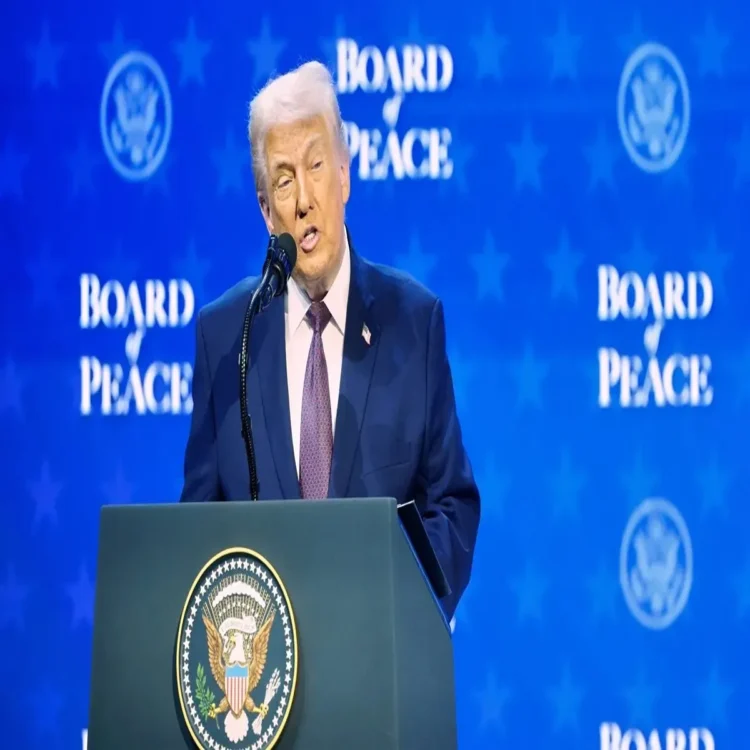
The gathering will be the first formal session of the body since it was created in January. Trump returned to the White House on Monday evening after spending the extended weekend at his Mar-a-Lago residence in Florida. Speaking to reporters aboard Air Force One during his return flight, he said several prominent world leaders would participate in the initiative, noting that coordination with the United Nations would take place in certain areas.
First Major Funding Commitment Announced
A day before the Washington meeting, Trump disclosed that participating countries had agreed to contribute significant funds toward humanitarian relief and reconstruction work in Gaza. According to his statement, the financial commitment exceeds $5 billion and will support housing, infrastructure repair, and essential services.
In addition to funding, member states have also pledged thousands of personnel to serve in an International Stabilization Force. The proposed deployment includes assistance for local policing and efforts aimed at maintaining order during the recovery period. The administration maintains that these steps are designed to ensure both immediate humanitarian relief and long-term stability for civilians in Gaza.
Trump described the Board of Peace as a potentially influential international platform and said he would serve as its chairman.
Launch in Davos and Membership Composition
The initiative was formally introduced last month during meetings in Davos, Switzerland, where more than two dozen founding members signed on to the project. Trump characterized the effort as part of a broader vision not only for Gaza’s recovery but also for advancing regional stability.
Countries that have accepted invitations to join include Israel, Qatar, Saudi Arabia, Turkey and Egypt. However, several key European allies of the United States have opted not to participate. Some officials in Europe have expressed reservations that the new body could overlap with or diminish the traditional role of the United Nations in international peacebuilding efforts.
Despite these concerns, the administration has emphasized that collaboration with existing global institutions remains part of its approach.
Reconstruction Vision and Development Plans
During the Davos event, Jared Kushner outlined what he described as a comprehensive redevelopment strategy for post-war Gaza. The proposal includes large-scale urban construction, the development of new residential areas and the creation of a coastal tourism corridor.
Kushner estimated that the broader development blueprint could require at least $25 billion in investment and potentially take two to three years to complete. He stressed, however, that immediate priorities would center on humanitarian assistance, including food distribution, medical services and restoring essential infrastructure.
The long-term vision, according to organizers, aims to combine reconstruction with economic revitalization in order to create sustainable growth.
Security Conditions and Regional Diplomacy
Trump has also linked the peace initiative to security expectations for Hamas, urging full demilitarisation as part of a wider settlement framework. He has indicated that durable reconstruction efforts would depend on meeting those conditions.
Meanwhile, Indonesia has signaled its willingness to contribute personnel to the stabilization mission. Brig. Gen. Donny Pramono stated that approximately 1,000 Indonesian troops could be prepared for deployment by early April, with the possibility of expanding the contingent to as many as 8,000, subject to final authorization from President Prabowo Subianto. Indonesian authorities have clarified that their forces would focus on peacekeeping and humanitarian support rather than combat operations.
The Washington meeting comes shortly after a second round of indirect discussions between the United States and Iran in Geneva. While those talks are separate from the Gaza initiative, they reflect broader diplomatic tensions in the region, particularly regarding Iran’s nuclear program. Trump has previously warned that failure to limit nuclear activities could prompt stronger measures.
As member nations convene in Washington, the scope, funding commitments and operational framework of the Board of Peace are expected to come into sharper focus in the days ahead.