
Supreme Court – Nine-Judge Bench to Hear Women’s Entry Cases in April
Supreme Court – The Supreme Court has scheduled an extensive hearing before a nine-judge Constitution bench to examine legal questions concerning women’s entry into religious places, including the Sabarimala Temple case.
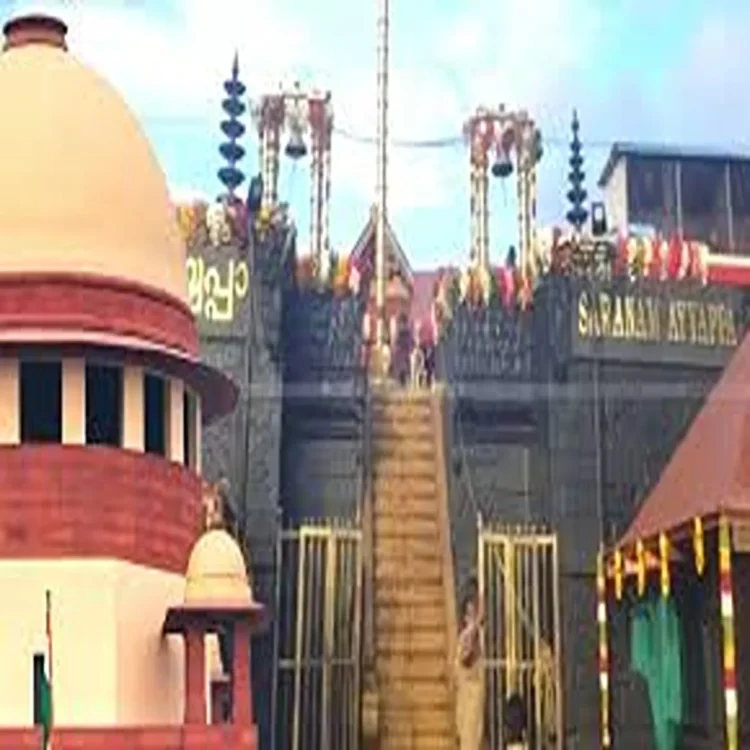
The Supreme Court on Monday announced that a larger bench of nine judges will begin final hearings on a group of petitions that address alleged discrimination against women in various religious practices and places of worship. The proceedings are set to commence on April 7 and are expected to conclude by April 22.
Hearing Schedule and Bench Formation
A three-judge bench led by Chief Justice Surya Kant, along with Justices Joymalya Bagchi and Vipul M. Pancholi, informed the parties that the Chief Justice of India will formally constitute the nine-judge bench. The matter will be taken up at 10:30 am on April 7.
According to the schedule outlined in court, petitioners seeking a review of the earlier Sabarimala judgment will present their arguments from April 7 to April 9. Those opposing the review will make their submissions between April 14 and April 16. Any rejoinder arguments will be heard on April 21, followed by concluding submissions from the court-appointed amicus curiae, with the hearings likely wrapping up on April 22.
The court directed all parties to file their written submissions by March 14 and emphasized strict adherence to the timeline.
Centre’s Position on Review Petitions
Appearing for the Union government, Solicitor General Tushar Mehta expressed support for the review petitions challenging the 2018 verdict that permitted women of all age groups to enter the Sabarimala shrine in Kerala.
The court designated advocate Krishna Kumar Singh as the nodal counsel representing those who favour a reconsideration of the judgment. Advocate Shashwati Pari has been appointed to coordinate arguments for those defending the original verdict.
Senior advocate K. Parameshwar, along with advocate Shivam Singh, has been appointed as amicus curiae to assist the bench. The amicus has been asked to compile and present the positions taken by all parties during the hearings.
Background of the Sabarimala Case
The dispute traces back to the 2018 ruling involving the Sabarimala Temple, a hill shrine in Kerala dedicated to Lord Ayyappa. In that landmark judgment, a five-judge Constitution bench held that women of all age groups could enter the temple, striking down the long-standing practice that restricted entry of women of menstruating age.
Subsequently, multiple review petitions were filed seeking reconsideration of the decision. In November 2019, a five-judge bench referred certain broader constitutional questions to a larger bench without deciding the review petitions. This move was challenged but later upheld by the Supreme Court.
On May 11, 2020, the apex court clarified that a five-judge bench, while exercising review jurisdiction, had the authority to refer questions of law to a larger bench for authoritative determination.
Key Constitutional Questions
The nine-judge bench is expected to examine significant constitutional issues related to religious freedom and equality. Among the core questions framed earlier are the interpretation and scope of Article 25 of the Constitution, which guarantees freedom of religion, and how it interacts with Article 26, which protects the rights of religious denominations to manage their own affairs.
The court will also consider whether individuals who are not members of a particular religious denomination can challenge its practices through public interest litigation.
Importantly, the reference to the larger bench is not limited to the Sabarimala matter alone. It also includes broader questions concerning the entry of Muslim women into mosques and dargahs, as well as issues related to Parsi women married to non-Parsi men being denied access to certain religious spaces such as the holy fire in an Agiary.
With the upcoming hearings, the Supreme Court is set to revisit complex legal questions at the intersection of gender equality and religious autonomy, a debate that continues to shape constitutional jurisprudence in India.
Supreme Court, Sabarimala Temple, women entry case, religious freedom, Article 25, Article 26, Constitution bench, gender equality, review petitions, Kerala,