
Navy – Indian Navy Takes Charge of Multinational CTF-154
Navy – The Indian Navy has formally assumed command of Combined Task Force 154, becoming the first from the country to lead the multinational training formation operating under the Combined Maritime Forces.
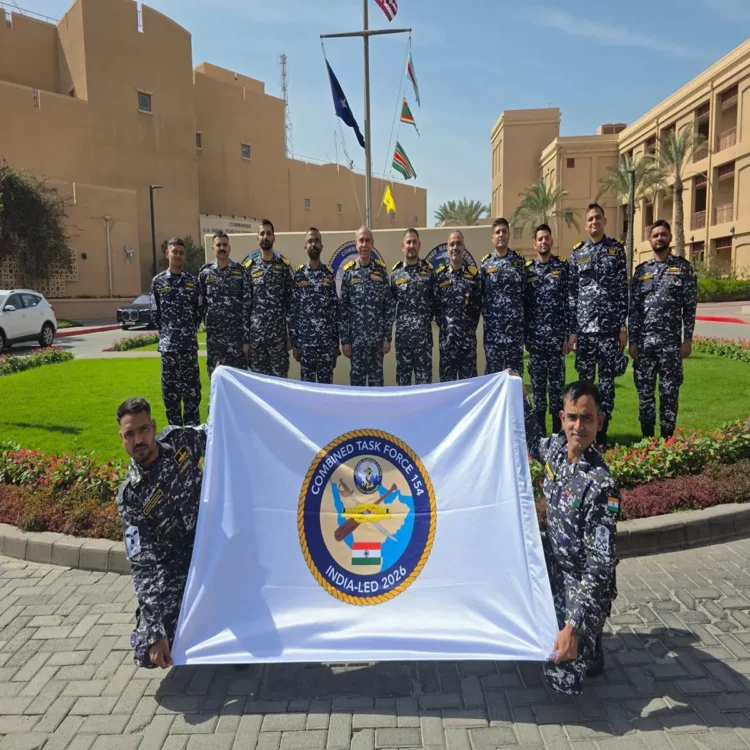
The change of command ceremony took place on February 11 at the headquarters of the Combined Maritime Forces in Manama, Bahrain. The event was overseen by Vice Admiral Curt A. Renshaw, who heads the Combined Maritime Forces, US Naval Forces Central Command and the US Fifth Fleet. Senior naval representatives from several member nations attended the ceremony, reflecting the collaborative character of the coalition.
Vice Admiral Tarun Sobti, Deputy Chief of the Naval Staff, represented India at the event. During the formal proceedings, Commodore Milind M. Mokashi, a recipient of the Shaurya Chakra, assumed leadership of CTF-154 from his Italian counterpart.
A Milestone in Multinational Naval Cooperation
CTF-154 is dedicated to strengthening the professional skills and operational readiness of participating navies within the 47-nation Combined Maritime Forces. India’s appointment to lead the task force marks a significant moment in its expanding maritime engagement and highlights growing international confidence in its naval capabilities.
Established in May 2023, CTF-154 was designed to focus exclusively on training and capacity development. Unlike operational task forces that conduct patrols or interdiction missions, this formation concentrates on preparing member states to effectively address maritime challenges through structured learning programs and exercises.
Focus on Training and Capacity Building
The task force’s training architecture is built around five core areas: Maritime Domain Awareness, Law of the Sea, Maritime Interdiction Operations, Maritime Rescue and Assistance, and Leadership Development. These pillars aim to provide participating navies with both technical knowledge and strategic insight.
Through regular Maritime Security Enhancement Training events, CTF-154 facilitates practical skill development and fosters coordination among partner nations. It also conducts exercises such as Compass Rose and Northern and Southern Readiness drills, which are structured to simulate real-world maritime security scenarios.
These initiatives are intended to bolster collective readiness against threats that affect regional and international waters, including illegal trafficking, piracy, and irregular migration. By strengthening institutional knowledge and operational coordination, the task force seeks to enhance long-term maritime stability.
Role Within the Combined Maritime Forces
CTF-154 operates alongside several other task forces within the Combined Maritime Forces framework. CTF-150 is primarily focused on broader maritime security operations, while CTF-151 concentrates on counter-piracy efforts. CTF-152 oversees security operations in the Arabian Gulf, and CTF-153 manages maritime security responsibilities in the Red Sea.
Headquartered in Bahrain, the Combined Maritime Forces is one of the world’s largest multinational naval partnerships. With participation from 47 countries, it works to maintain security and stability across vital sea lanes in the Middle East and surrounding waters.
Expanding India’s Maritime Footprint
India’s leadership of CTF-154 reflects its evolving role as a key security partner in the Indian Ocean Region and beyond. In recent years, the Indian Navy has expanded its operational reach through joint exercises, coordinated patrols, anti-piracy missions, and humanitarian assistance efforts.
By taking command of the training-focused task force, India is expected to shape programs that align with emerging maritime challenges while promoting deeper cooperation among member states. Officials indicated that the Navy intends to use its tenure to deliver impactful training initiatives and further strengthen partnerships aimed at ensuring secure and open sea lanes.
The development underscores India’s broader objective of contributing to a stable maritime environment that supports global trade, energy flows, and regional prosperity.