
NationalSong – Madhya Pradesh Enforces Full Vande Mataram Directive
NationalSong – Madhya Pradesh has moved swiftly to adopt the Union government’s latest directive concerning the rendering of the national song Vande Mataram and the national anthem Jana Gana Mana. Chief Minister Mohan Yadav announced on Thursday that the state would implement the new order without delay.
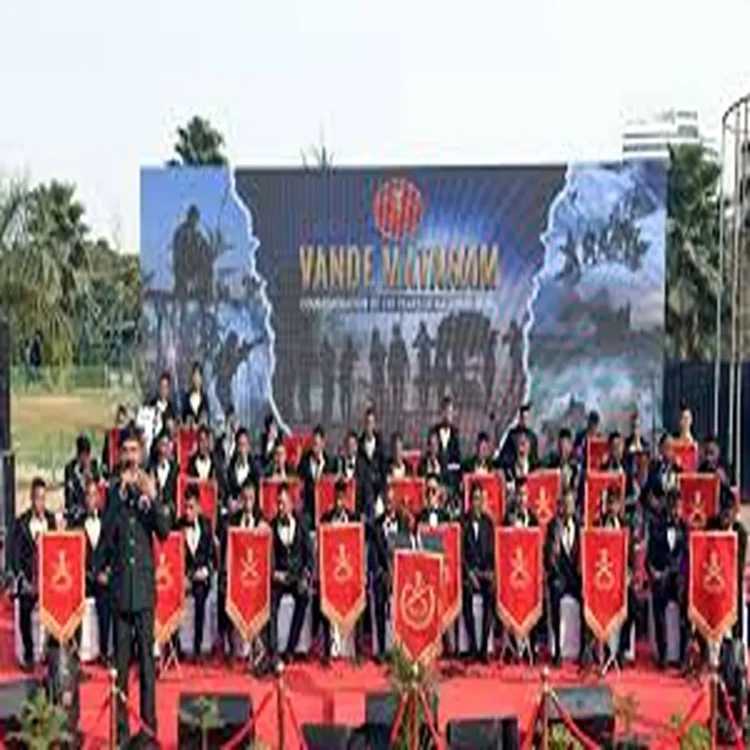
Addressing citizens, Yadav described the Union Home Ministry’s decision as an important step toward reinforcing collective national identity. He noted that the directive would serve as a reminder of the sacrifices made during India’s freedom movement and help strengthen the spirit of unity across the country.
Immediate Adoption of Centre’s Directive
The Chief Minister stated that, under the leadership of Narendra Modi, the Ministry of Home Affairs had decided that all six stanzas of Vande Mataram would be sung before the national anthem at official events. Madhya Pradesh, he said, fully supports the move and has begun implementing it across state functions.
Yadav expressed appreciation for the Centre’s decision, saying the inclusion of the complete version of Vande Mataram reflects respect for the nation’s cultural and historical heritage. He emphasized that the state government considers it a matter of pride to align itself with the updated protocol.
Details of the Union Home Ministry Order
According to the order issued by the Ministry of Home Affairs on January 28, the officially recognized six-stanza version of Vande Mataram is to be performed at government ceremonies. Whenever both the national song and the national anthem are part of an event, Vande Mataram will precede Jana Gana Mana.
The directive outlines several occasions where the national song will now be rendered. These include events marking the arrival and departure of the President and Governors at official functions. It will also be sung before and after the President’s address to the nation broadcast on radio and television, as well as during ceremonies involving the unfurling of the national flag.
Inclusion in Awards and Public Events
The order further extends to civilian award functions, including prestigious ceremonies such as the Padma Awards. Vande Mataram will be performed at such gatherings, particularly when attended by the President, during arrival and departure segments.
In addition, the national song is set to be played in certain public settings, including cinema halls. However, the directive clarifies that standing will not be mandatory in these locations, distinguishing them from formal state occasions where established protocols apply.
Historical Context and Previous Practice
For decades, it has been customary to sing only the first two stanzas of Vande Mataram at public events. This practice dates back to the period before independence and was later acknowledged during discussions in the Constituent Assembly. At that time, concerns were raised by certain groups regarding specific references within the text, leading to a more limited version being adopted for common use.
The recent directive marks a departure from that long-standing convention by formally recognizing and mandating the performance of all six stanzas at designated official functions.
The announcement also comes during a milestone year for Vande Mataram, as the Union government observes the 150th anniversary of the song. The occasion was commemorated with a special discussion during the Winter Session of Parliament in 2025, reflecting its enduring significance in India’s national history.
Under existing legal provisions, any deliberate act that prevents others from showing due respect to the national anthem—or to the national song as now specified—can attract penalties, including imprisonment of up to three years. Authorities have reiterated that respect for national symbols remains a matter governed by law.
With Madhya Pradesh promptly implementing the updated guidelines, the directive is expected to shape the format of official ceremonies across the state in the months ahead.