
LabourStrike – Nationwide Protest Targets Centre’s Policy Reforms
LabourStrike – A countrywide general strike unfolded on Wednesday as trade unions and farmers’ organisations mobilised workers across cities, towns and villages to protest against the Union Government’s recent policy decisions. Demonstrations were reported from multiple states, with participants raising concerns over labour reforms, agricultural policies and trade agreements.
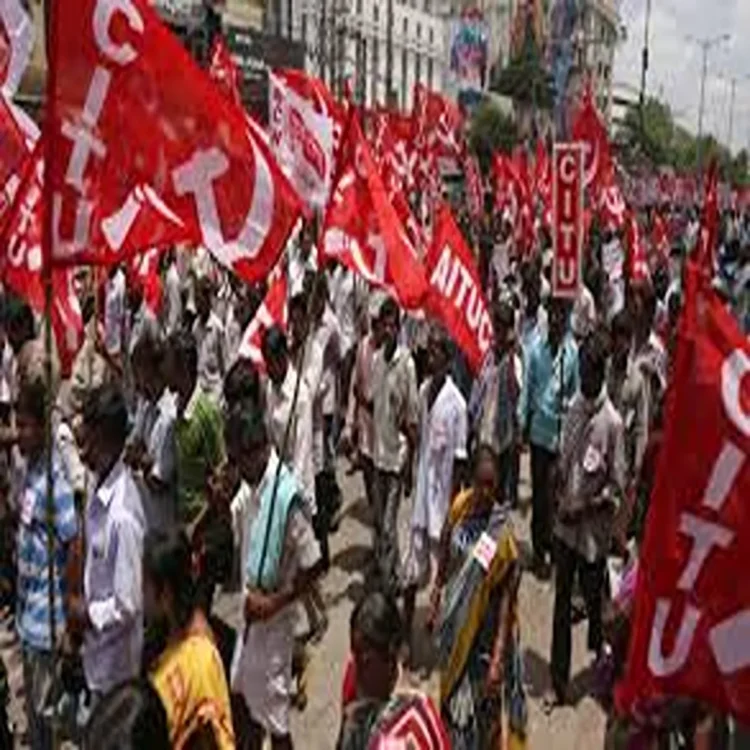
Massive Turnout Across States
In Chennai’s Guindy industrial belt, members of several trade unions gathered in large numbers, echoing similar scenes witnessed elsewhere in the country. Addressing the gathering, CITU State President A. Soundararajan criticised what he described as anti-worker labour reforms introduced by the Centre. According to organisers, protests and road blockades were staged at thousands of locations nationwide.
Union representatives stated that the strike had been coordinated by ten central trade unions along with more than 50 national federations representing agricultural labourers and farmers. Leaders involved in the mobilisation estimated that nearly 25 crore workers from both organised and unorganised sectors were expected to participate in the action.
Opposition to the Four Labour Codes
A key focus of the protest was the demand to withdraw the four Labour Codes enacted by the Centre. Trade union leaders argue that the codes consolidate 25 existing labour laws but dilute long-standing safeguards for workers.
Soundararajan contended that the revised framework weakens essential protections, including the right to strike, collective bargaining mechanisms and the process for registering trade unions. He further alleged that workers in the unorganised sector, including Anganwadi staff, ASHA workers, midday meal employees and other frontline personnel, have not been provided adequate safeguards under the new system.
Concerns Over Agricultural Commitments
The strike also drew attention to unresolved issues raised during the farmers’ protest movement. Soundararajan said assurances made during earlier negotiations had not been fully implemented. He pointed to the recommendations of the M.S. Swaminathan Commission, particularly those related to fair pricing for farm produce.
According to him, the demand for a legal guarantee of Minimum Support Price remains unmet. Farmer organisations participating in the strike reiterated that predictable pricing and procurement policies are crucial for safeguarding rural livelihoods.
Rural Employment and Welfare Issues
Another point of contention was the future of the 100-day rural employment scheme. Union leaders claimed that budgetary constraints and administrative changes have weakened the programme, which has historically provided income support during times of economic distress in rural areas.
They argued that the scheme played a vital role during periods of financial hardship and should be strengthened rather than curtailed. Concerns were also raised about proposed amendments to the Seed Act, with protest leaders alleging that the changes could favour large corporations and promote genetically modified seeds at the expense of traditional farming practices.
Power Sector and Legislative Changes
The Electricity Amendment Bill featured prominently in speeches delivered at the protest sites. Soundararajan claimed that the proposed legislation could accelerate privatisation in the power sector and potentially affect subsidised electricity schemes. He also expressed reservations about amendments made to various other laws, including criminal statutes and the Motor Vehicles Act, stating that they require wider consultation and public debate.
Trade Agreements Under Scrutiny
Recent trade negotiations with the United States and the European Union were also criticised during the demonstrations. Trade union representatives argued that unrestricted imports of agricultural and dairy products could intensify competition for domestic producers. They warned that such agreements might have long-term implications for farmers and small-scale milk producers.
Call for Wider Support
Concluding his address in Chennai, Soundararajan urged political parties and the public to back the strike, stating that the issues raised go beyond labour reforms and touch upon economic self-reliance and social protections. Organisers indicated that further consultations would determine the next course of action depending on the government’s response.
As the nationwide strike continues to unfold, authorities are monitoring disruptions while union leaders maintain that dialogue and policy review are necessary to address the concerns raised by workers and farmers.