
Op Sindoor : established India’s position of guaranteed kinetic reaction to cross-border terrorism and set new standards for military tactics Professionals
Op Sindoor: In response to the Pahalgam terror assault, India responded appropriately, compelling its western neighbor to seek a truce. This year, India demonstrated its military power, technical brilliance, the capabilities of its indigenous platforms, and its vow of zero tolerance to terrorism.
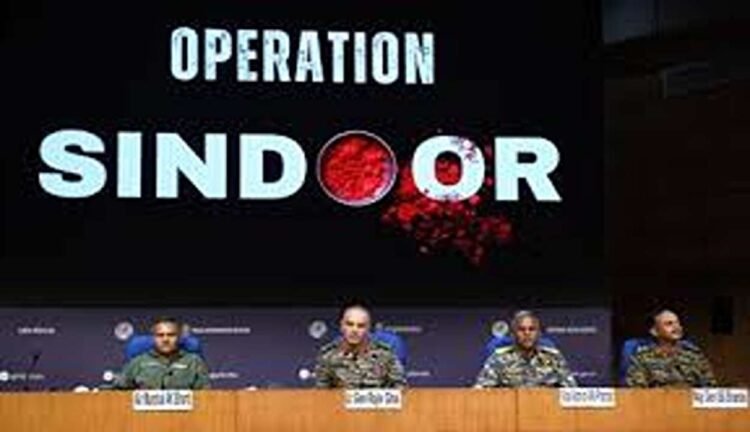
India successfully repulsed Islamabad’s further escalation by bombarding Pakistani airbases after striking terror infrastructure in Pakistan and Pakistan-Occupied Jammu and Kashmir on May 7 as part of Operation Sindoor.
According to experts, Operation Sindoor demonstrated to the world that India will confront terrorism as well as nations that are known to be terrorist hotspots. India has now moved from a posture of surgical retaliation to one of doctrinal deterrence, guaranteeing retaliation for any proven act of cross-border terror.
Air defense has become the new sword arm of contemporary warfare, according to Lieutenant General Kanwal Jeet Singh Dhillon (retd), who has served eight terms in Jammu and Kashmir and the Northeast’s counterinsurgency and counterterrorism operations regions.
He pointed out that Pakistan’s support for cross-border terrorism has not changed over the years, despite the emergence of several newer realities in the Indian neighborhood, such as the Gen Z protest in Nepal, the developments in Bangladesh under Interim Government Advisor Muhummad Yunus, and the strengthening of ties between India and Afghanistan.”The Pahalgam terror attack was carried out by Pakistan to deflect attention from their internal problems of ineffective politics, military corruption, economic meltdown, and the failure of their diplomatic outreach, among other factors,” he said. “Pakistan’s only goal in life is to keep India internally unstable.”Pakistan failed to recognize that India is a different country now than it was when it carried out the savage Pahalgam assault. It’s a new India, the world’s biggest democracy with a strong political will, the fourth-largest economy in the world, and a military might. The emergence of India was not included into Pakistan’s terror calculation.
He made it clear that “Operation Sindoor 2.0 will hit them even harder – not only militarily, but also economically, politically, and diplomatically” if Pakistan makes another attempt.
During the Pulwama terror attack, the Balakote airstrikes, and the repeal of Article 370, Lt Gen Dhillon, who oversaw operations 15 Corps (Chinar Corps), which was in charge of military operations on the Line of Control and in the Kashmir Valley, emphasized how Operation Sindoor established a new standard and a new norm in the fight against terrorism.
He emphasized in particular the significance of air defense, which has become the new sword arm in contemporary warfare. According to him, the advent and use of more recent technology have altered the nature of warfare. He discussed how crucial it is to adapt one’s own tactics and methods to the ever-evolving technology used in all facets of warfighting.Operation Sindoor 1.0 established new standards for military tactics and international strategy. The measurable indicators of success in previous conflicts were the crossing of boundaries, the conquest of land, and the capturing of prisoners of war. The quantifiable metrics of success were established when we freed all of East Pakistan and captured 93,000 Pakistani prisoners of war during the 1971 Indo-Pak conflict. “What we witnessed during Operation SINDOOR was that, for the first time in world history (excluding the limited operations of Operation Kargil and Operation Vijay), two nuclear powers went to war, and not a single soldier, tank, or gun crossed the line of control or international boundary—this is a new face of future wars,” he said.
In addition to F-16s and the AWACS, Air Defense became the war’s sword arm and played a significant role in defeating Chinese radars, planes, missiles, and drones. These are the new standards that have been established.
“Today’s warfare will not be the conventional trench warfare of the Second World War,” he said.It will not be the kind of attrition warfare that was prevalent in the 1970s, 1980s, and 1990s. Air defense, electronic warfare, cyberwarfare, and space warfare will dominate warfare in the future. It will be a non-contact conflict.
He elaborated on the idea by saying that conflicts would no longer be confined to the military sphere.The battle will be waged in the economic sphere, namely in the area of upsetting the banking, railroad, airline, and electrical systems domestically. Cyber, space, electronic, and kinetic realms will be used in stand-alone or overlapping operations to destroy military and economic assets both onshore and offshore. Thus, future conflicts will be different: quick, costly, deadly, and very visible,” he said.
“Whether you won or lost a war is not going to be the only aspect – how you perceive it on social media and the media is going to be a parallel warfare, and India needs to gear up for this narrative warfare,” he stated when discussing the significance of the struggle of narratives and perception management.
In order to regulate perceptions based on openness and truth, he proposed the need of a centralized, integrated information center.
When asked how India’s counterterrorism ideology has changed over the last ten years, he restated the guidelines Prime Minister Narendra Modi had outlined in May, just after Operation Sindoor.
Lieutenant General Dhillon said that “in our counter-terrorism strategy, we are not going to differentiate between a terrorist and the organization he belongs to and the country supporting it- all three are terrorists and we will take necessary actions as per our national interests” .
He emphasized how Operation Sindoor demonstrated to the world that India would confront terrorism head-on, unlike the nations who are notorious for being the world’s terrorist hotspots.
He went on to say that “the world should draw the lessons and learn from the way we conduct our counter-terror operations” due to the surgical accuracy of India’s counter-terrorist operations and the fact that they have guaranteed zero to little collateral damage.
Another lesson that the world might take away from India’s military reaction, according to renowned author Lt Gen Dhillon, “is to be precise with the selection of weapon systems.””Our counterterrorism operations are highly moral and ethical,” he said.
Operation Sindoor was the most severe India-Pakistan confrontation of the twenty-first century, according to former High Commissioner to Pakistan Ajay Bisaria.
He pointed out that Operation Sindoor was different from India’s earlier anti-terrorism measures. It demonstrated both India’s expanding technology advantage and the traditional power difference.Operation Sindoor was a high-tech, full-spectrum offensive and defense operation. There was not a single soldier or man aboard an aircraft that crossed the boundary. It used multilayer air defenses, electronic warfare, loitering weapons, and drones. The Integrated Air Command and Control System (IACCS) of the IAF was responsible for bringing everything together. In an email interview, Bisaria said, “It was also a clear demonstration of indigenous (Aatmanirbhar) capabilities, integrating technologies obtained from global partners.”Cross-border terrorism would henceforth be seen as an act of war rather than just a diplomatic or law enforcement matter, India made plain. India demonstrated that it will not stick to diplomatic protest or symbolic acts by striking sites deep into Pakistan and Pakistan-occupied Kashmir. No matter where terrorism originates, it will be dealt with force,” he said.
According to Bisaria, India’s military response was the most recent development in a doctrine known as “Integrated Deterrence,” which was taken and modified from more general international security terminology in a nuclear context but frequently modified to fit the particulars of the Indo-Pak relationship.The foundation of integrated deterrence is a multifaceted strategy that includes media control, economic leverage, diplomatic preemption, and military preparedness. It incorporates “layered coercion” and “proactive signaling,” going beyond reactive defense. India clearly proven each component in Operation Sindoor,” Bisaria told ANI.
He also emphasized the powerful political message that Operation Sindoor sent.The Prime Minister openly connected India’s military reaction to the Pahalgam terror assault. This indicated that there will be kinetic repercussions from a move to a predictable doctrine of terror strikes. Its goal was to use punishment to reinstate deterrence. This stance, which included both air and ground attacks, has now become a philosophy of guaranteed reaction to cross-border terrorism.
This set of measures, according to the former High Commissioner to Pakistan, marked a significant shift from India’s prior stance of strategic caution.India has now moved from a stance of surgical reprisal to one of ideological deterrence, guaranteeing that every proved act of cross-border terror would be met with retaliation and classified as an act of war. These are not stand-alone acts, but rather components of a larger strategy meant to prevent and dissuade Pakistan and gradually mold its conduct.”
He discussed how India’s counterterrorism strategy has changed in the last ten years. He stated that a global naming and shame of Pakistan for terrorism and an effort to put together a global concert against terror were diplomatic goals, noting that up until 2008, India primarily relied on diplomacy and internal security, employing police, intelligence, and laws like the UAPA as the primary tools.Clearly, this was insufficient. India started directly attacking terror facilities with the 2016 surgical strikes and the 2019 Balakot airstrikes. That altered the stance, which after the Pahalgam incident in 2025 became a policy of guaranteed kinetic reaction to transnational terrorism.”India’s strategy is often seen as striking a balance between being cautious enough to prevent escalation and powerful enough to deter. It has set a good example by focusing just on terror infrastructure and avoiding civilians or associated military assets. Given the ongoing grinding hostilities in Ukraine and West Asia, this is especially glaring,” Bisaria said.
Throughout his diplomatic career, Bisaria held a number of roles, including High Commissioner to Canada. He emphasized how the world has taken notice of the transition from victim to responder, particularly in a nuclear-armed area like South Asia.India has to do this activity much better, especially in international media, where Pakistan often spreads false information quickly,” he said.
Operation Sindoor’s overarching political-military goal was to hold Pakistan accountable for engaging in a proxy war. India showed its political savvy, moral character, military might, and national fortitude. The military leadership of the nation also showed maturity and strategic insight.
India is strengthening its own armed forces. India’s defense exports, which now total Rs 23,500 crore, are also growing quickly.