
Trump: signs the NDAA in order to increase military cooperation with India
Trump: The National Defense Authorization Act (NDAA) for fiscal year 2026, which was signed into law by US President Donald Trump, is a comprehensive defense package that specifically calls for increased US military cooperation with India and the Quad as part of Washington’s Indo-Pacific strategy.
$890 billion in national defense expenditures is authorized under the law. In order to promote a free and open Indo-Pacific region, it instructs the United States to increase engagement with India, notably via the Quadrilateral Security Dialogue.
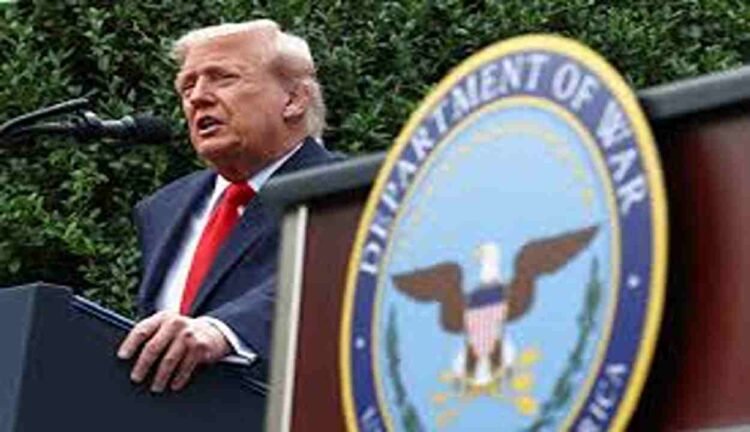
The Act, which codifies elements of over a dozen executive actions taken by his administration, “will enable the Department of War to carry out my Peace Through Strength agenda, protect the homeland from domestic and foreign threats, and strengthen the defense industrial base,” according to Trump’s signing statement.
Expanded bilateral and multilateral military engagements with India, greater military exercise participation, higher defense commerce, and tighter collaboration on disaster relief and humanitarian aid are all demanded by the Act. Additionally, it names maritime security as a particular area where the US and India should work together more closely.
A collaborative US-India examination of nuclear liability regulations via the US-India Strategic Security Dialogue is also required under the NDAA.
It instructs the Secretary of State to set up a regular consultation process with India in order to evaluate how the 2008 civil nuclear agreement is being implemented, talk about ways that India can bring its domestic nuclear liability laws into compliance with international standards, and create cooperative diplomatic plans for civil nuclear cooperation.
Within 180 days of passage, and then every year for the next five years, the State Department must report to Congress.
The Act mandates that US evaluations take into account Russia’s military cooperation with India as well as its overall military posture that impacts the Indo-Pacific and other areas.
In addition, the NDAA authorizes the State Department to create an Ambassador-at-Large for the Indian Ocean Region. The role would concentrate on thwarting the People’s Republic of China’s destructive influence in the area and coordinate US diplomatic efforts across Indian Ocean nations.
Along with authorizing $1 billion for the Taiwan Security Cooperation Initiative, the NDAA contains clauses that prohibit Chinese military firms from using third-party nations to get around US limitations.
In addition to protecting civilian defense workers, the NDAA authorizes a 3.8% pay increase for US military troops and funds housing, health care, and childcare.
The NDAA, which has been passed yearly for almost 60 years, establishes the objectives for US defense expenditure and policy. The FY26 statute explicitly situates increased regional, military, and nuclear cooperation with India within the parameters of US defense law.