
India-US: In the Trump 2.0 era ties are put to the test from friendship to brinkmanship
India-US : relations were characterized by stark contrasts in 2025, as growing economic conflicts, inequitable strategic cooperation, and recurrent uncertainty coexisted with the presidents’ public friendliness. The cooperation was still referred to as “special” by both administrations, but events throughout the year revealed tensions that put the stability of bilateral relations to the test.
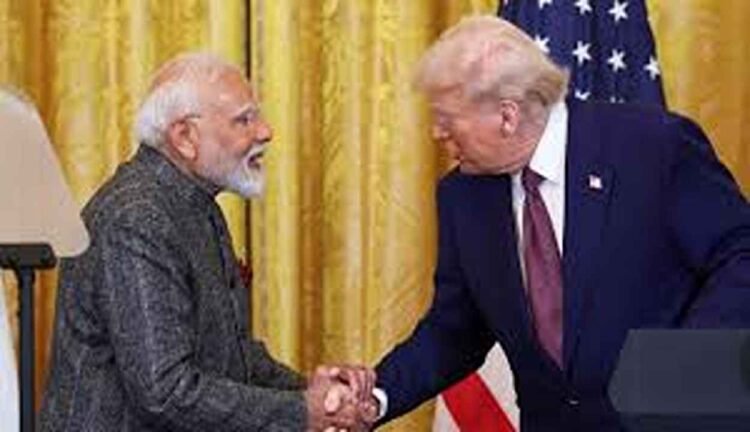
The alliance, which was first portrayed as being based on long-term strategic interests and shared democratic ideals, gradually reflected shifting political priorities and US President Donald Trump’s erratic style. Underlying conflicts were more difficult to ignore despite frequent declarations of intimacy.
Weeks after President Trump took office on January 20, Prime Minister Narendra Modi visited Washington on February 12 in an apparent effort to establish a positive agenda and stabilize ties. Expectations of success were momentarily raised during the visit as discussions centered on resuming talks for a bilateral trade deal and growing general commerce.
That hope was short-lived.
The broader geopolitical landscape changed when the US administration failed to provide a prompt settlement to the Russia-Ukraine crisis in its first 100 days in office. In light of this, tensions between the US and India increased.
From comradery in public to conflict in commerce
When compared to previous years, the change was very apparent. During their combined speech to a throng of over 50,000 people at the ‘Howdy Modi’ event in Houston in September 2019, President Trump and Prime Minister Narendra Modi exuded warmth and political unity. India was called a “true friend in the White House” by PM Modi, while Trump called him a personal buddy.
That stage seems to be far behind us by 2025.
Trade tensions escalated in August as the US imposed up to 50% tariffs on Indian goods. Driven by worries about trade imbalances, domestic political considerations, and divergent negotiation strategies, the action signaled a dramatic shift from symbolic public goodwill to combative trade actions.
There had been indications of tensions previously. President Trump called the import taxes imposed by India on Harley-Davidson motorbikes “unfair” in 2018. Subsequently, India was removed from the US Generalized System of Preferences, which had an impact on billions of dollars’ worth of exports. This was followed by the imposition of “America First” tariffs, which included 25% on steel and 10% on aluminum.
Stress is increased by the India-Pakistan dispute
Events pertaining to India-Pakistan ties further exacerbated tensions. Following the incident in Pahalgam on April 22 that claimed the lives of 26 people, the majority of whom were tourists, President Trump frequently claimed that the United States had mediated a truce between the two neighbors.
Trump said on May 10 that he had intervened to achieve a “immediate ceasefire” with Vice President JD Vance. India continuously denied the claim, even as Pakistan’s stance changed over time.Indian Foreign Secretary Vikram Misri said, “PM Modi made it clear to President Trump that there was no discussion at any point during this period on subjects like India-US trade deals or US mediation between India and Pakistan.”Through established military channels and at Pakistan’s request, direct talks for a halt to military action took place between India and Pakistan. Prime Minister Modi emphasized that India has never and would never tolerate mediation.
Despite initial expectations, trade negotiations fail.
Expectations that the two parties may reach a comprehensive trade deal were rekindled in the beginning of 2025, with goals to increase bilateral commerce to USD 500 billion by 2030. These aspirations were momentarily reaffirmed during PM Modi’s visit to the United States.
President Trump did, however, declare an extra 25% duty on Indian products on July 30. The announcement of a trade deal with Pakistan came next. India is now one of the most severely taxed trade partners of the United States after Trump issued an executive order on August 6 raising taxes on Indian goods to 50%.
A mysterious indication about geopolitical alliances
On September 5, President Trump shared a picture of Prime Minister Modi with Russian President Vladimir Putin and Chinese President Xi Jinping along with a caustic comment, which increased the level of uncertainty.It seems that deepest, darkest China has supplanted Russia and India. I hope their future together is long and successful.
The post was made at a time when trade tensions were at an all-time high and Washington was becoming more concerned about India’s ongoing energy imports from Russia and unresolved tariff issues.”Special relationship” reinforced
Within a day, President Trump made an effort to minimize rumors of a breakup by highlighting the two nations’ close personal relationship and wider strategic alliance.Narendra Modi will always be a buddy of mine. He is an excellent prime minister. He’s fantastic. However, I don’t like what he’s doing at the moment. However, there is a unique bond between the US and India. There is no need for concern. We just sometimes experience these moments.
Despite ongoing disputes over trade policy and India’s acquisition of Russian oil, the statements were made.
Tariffs, internal politics, and rice
When President Trump claimed that India was “dumping” rice into the US market and threatened to impose extra taxes on Indian rice imports, trade rhetoric intensified. Tariffs, he said, could “easily resolve the problem”
The remarks were delivered during a roundtable at the White House with top officials, including Agriculture Secretary Brooke Rollins and Treasury Secretary Scott Bessent, and representatives from the agricultural industry. Trump unveiled a USD 12 billion government aid plan for American farmers at the same meeting.
Trump questioned India’s trade policies throughout the conversation.Tell me about India, please. Why is that permitted in India? Tariffs must be paid. Is there a rice exemption for them?
“But they shouldn’t be dumping,” Trump said in response to being told, “No sir, we’re still working on their trade deal.” I heard that, after all. Others told me that. They are unable to do it.
Continued strategic assurances
The US persisted in highlighting India’s strategic significance in spite of economic disputes. “India is home to one of the world’s oldest civilizations,” President Trump said on X, according to the US Embassy in India. It is a fantastic nation and a key strategic ally of the United States in the Indo-Pacific area. PM Modi is a wonderful friend of ours.
Continued diplomatic engagement
Official remarks indicated that diplomatic relations were still functioning. Prime Minister Narendra Modi and President Trump recently spoke over the phone on regional and international challenges in addition to bilateral ties. Following PM Modi’s meeting with Russian President Vladimir Putin, the discussion took place at a time when international attempts to resolve the Russia-Ukraine conflict via an extended peace proposal put out by Trump were resuming.
The US’s aspirations for more access to Indian markets for agricultural exports including maize and soybeans were among the topics of discussion during the trade discussions. The encounter was subsequently characterized by PM Modi as “warm and engaging”.
A year with conflicting messages
India-US ties as the year comes to an end show a complicated balance between collaboration and conflict. Sharp trade conflicts and political instability have been chronic obstacles despite the continuation of strategic discussion.
Both governments insist that the relationship is still too important to be disrupted, despite some US politicians’ warnings that harsh trade policies may strain relations with a crucial Indo-Pacific ally.
2025 demonstrated to New Delhi and Washington that the cooperation is still developing, influenced not just by domestic interests and leadership styles but also by global geopolitical trends.